

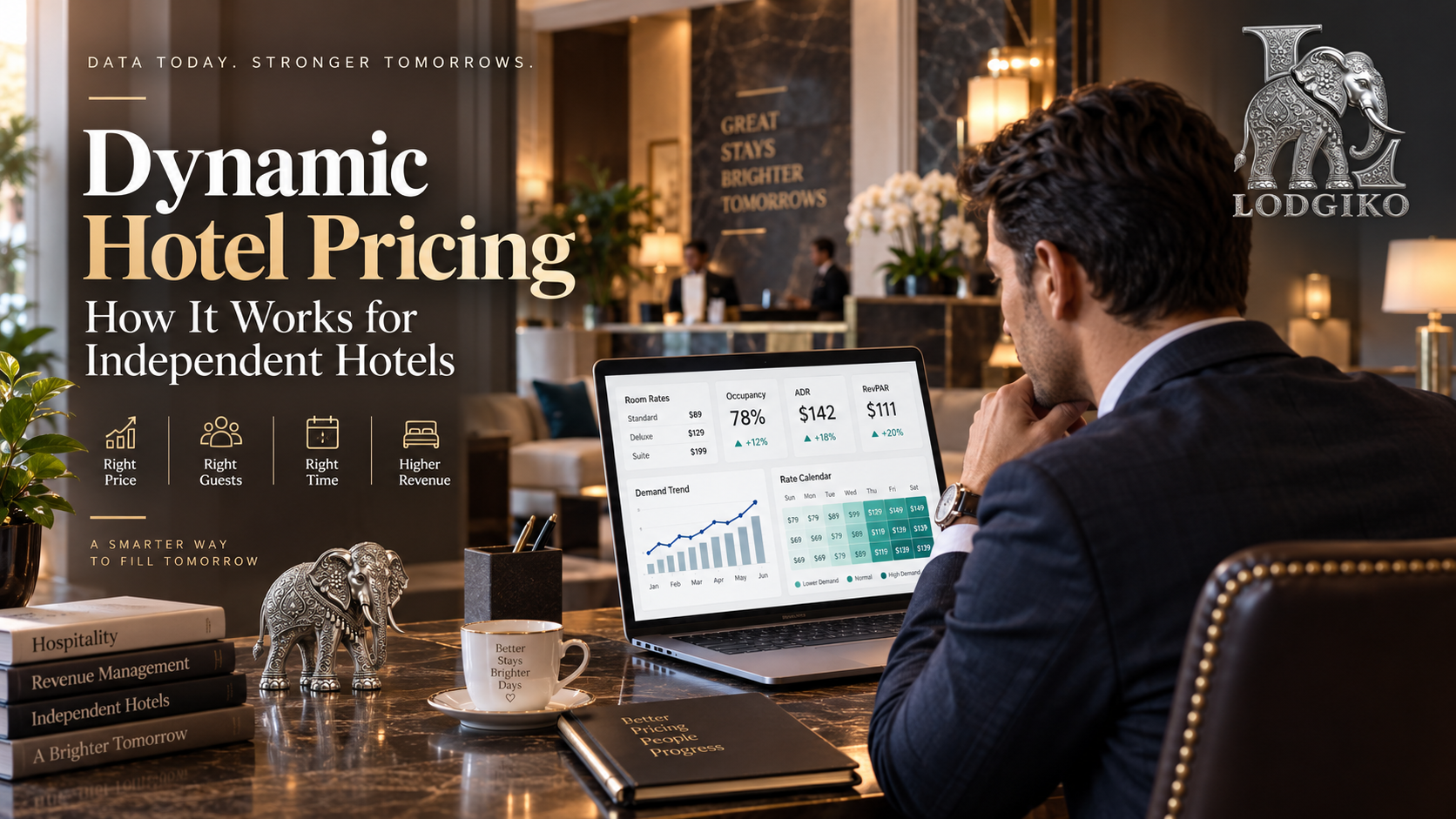
By Sofia Dhanani
For many independent hotel owners, changing the room rate feels risky.
You set a price for a room, publish it on your website and OTAs, and hope guests book. If rooms are not selling, the natural reaction is to lower the price. If the hotel is busy, some owners may increase the price—but often only after most of the rooms have already been sold.
That approach leaves money on the table.
Hotels do not sell exactly the same product at exactly the same value every night. A room on a quiet Tuesday in February may have a very different market value from the same room on a Saturday during a local event. A room booked 30 days in advance may also require a different pricing strategy from a room booked three hours before arrival.
This is where dynamic hotel pricing comes in.
Dynamic pricing allows an independent hotel to adjust room rates according to demand, booking pace, seasonality, local events, occupancy, competitor pricing, room availability, booking window and other market conditions.
The goal is not simply to charge more.
The goal is to sell the right room, to the right guest, at the right price, through the right channel, at the right time.
For a small hotel with limited inventory, that can make a significant difference to revenue.
What Is Dynamic Pricing for Hotels?
Dynamic pricing for hotels is the practice of changing room rates based on current and expected market conditions rather than keeping the same price throughout a season or month.
Instead of saying:
“Our standard room is always $79.”
a hotel using dynamic pricing might have a structure such as:
- $59 on a low-demand Tuesday
- $69 on a normal Wednesday
- $79 on a stronger Thursday
- $89 on a Friday
- $99 on a high-demand Saturday
- $119 during a major local event
These numbers are only an illustration. The actual rates should come from the property’s market, costs, competition, demand and positioning.
Dynamic pricing does not mean changing prices randomly.
It means having clear rules for when and why prices should change.
That distinction is important.
A hotel owner should be able to look at today’s rate and explain:
Why is the room $89 today instead of $69?
If the answer is simply “because the system changed it,” there is a problem.
Good revenue management combines technology with human judgment.
Why Independent Hotels Need Dynamic Pricing
Large hotel chains have revenue managers, sophisticated PMS platforms, data analysts and automated pricing systems.
Independent hotels often have one person doing several jobs.
The owner may be handling:
- Front desk operations
- Guest complaints
- Housekeeping
- OTA management
- Accounting
- Marketing
- Staff scheduling
- Maintenance
- And pricing
That makes pricing especially difficult.
But smaller hotels actually have one important advantage: they can react quickly.
A 20-room independent hotel does not need a massive revenue department to begin using revenue management principles.
It needs:
- Accurate room availability
- A basic understanding of demand
- Competitive information
- A sensible pricing structure
- Regular monitoring
- A PMS or booking system that makes rate changes manageable
The technology can become more sophisticated as the hotel grows.
The fundamentals remain the same.
The Problem With One Fixed Hotel Rate
Consider a 20-room independent hotel charging $70 every night.
On a slow Tuesday, perhaps only 8 rooms sell.
On Friday, 18 rooms sell.
On Saturday, all 20 rooms sell.
At first glance, the owner may think:
“Saturday was great. We sold out.”
But the real question is:
Could the hotel have sold those rooms for more?
If guests were booking quickly and competitors were already at $95 or $105, selling every room at $70 may have created occupancy—but not necessarily optimized revenue.
Now consider the opposite.
Suppose Tuesday demand is weak and the hotel is selling only 3 rooms at $70.
A hotel might lower the price to $60 to encourage demand.
That could make sense.
But if the hotel is already priced below comparable properties and demand is weak because of seasonality, lowering the rate to $50 may simply reduce revenue without generating enough additional bookings.
Dynamic pricing is about finding the balance.
The Three Numbers Every Hotel Should Understand
Dynamic pricing becomes easier when an owner understands three fundamental hotel metrics.
Occupancy
Occupancy tells you how much of your available inventory is sold.
Occupancy = Rooms Sold ÷ Available Rooms × 100
For example:
A 20-room hotel sells 15 rooms.
Occupancy is:
15 ÷ 20 × 100 = 75%
Occupancy tells you how full the hotel is.
It does not tell you whether you charged enough.
ADR
ADR means Average Daily Rate.
ADR = Room Revenue ÷ Rooms Sold
If a hotel sells 15 rooms and generates $1,200 in room revenue:
$1,200 ÷ 15 = $80 ADR
ADR tells you the average price achieved for sold rooms.
RevPAR
RevPAR means Revenue Per Available Room.
A simple formula is:
RevPAR = Room Revenue ÷ Available Rooms
Using the same example:
$1,200 ÷ 20 = $60 RevPAR
RevPAR brings occupancy and rate together.
This is important because a hotel should not chase occupancy at any price.
Selling every room cheaply is not necessarily better than selling fewer rooms at a healthier rate.
Dynamic Pricing Is Not the Same as Constantly Changing Prices
This is one of the most common misunderstandings.
Dynamic pricing does not mean changing your rate every hour simply because you can.
Too many price changes can create confusion for staff and make it difficult to understand what is actually driving revenue.
Instead, independent hotels can create pricing levels or rate bands.
For example:
Demand Level Example Rate Very Low $59 Low $69 Normal $79 Strong $89 High $99 Peak $119+ Again, these are illustrative rather than universal rates.
The hotel determines its own pricing ladder based on its market.
The important part is having a logical relationship between demand and price.
What Causes Hotel Rates to Change?
Several factors can influence dynamic pricing.
Current Occupancy
If the hotel is already 80% full for tomorrow night, the remaining rooms may have greater value than they did when the hotel was only 30% occupied.
The hotel may therefore move to a higher rate level.
But occupancy alone should not determine the price.
Booking Pace
Booking pace is one of the most useful revenue-management signals.
Suppose your hotel normally has:
- 5 bookings 14 days before arrival
- 8 bookings 7 days before arrival
- 12 bookings 3 days before arrival
This week, you already have 15 bookings seven days before arrival.
That is a signal.
Demand is moving faster than normal.
A hotel should investigate whether rates should be increased or discounts restricted.
What Is Pickup?
Pickup refers to the number of new reservations received during a specific period.
For example:
Monday morning:
20 rooms booked for Friday.
Tuesday morning:
23 rooms booked for Friday.
The hotel picked up 3 additional reservations.
Tracking pickup helps revenue managers understand the direction of demand.
A hotel does not need complicated software to start.
A simple spreadsheet can record:
- Date
- Rooms available
- Rooms booked
- Pickup
- ADR
- Competitor rates
- Events
- Cancellation levels
Over time, this becomes valuable historical data.
Booking Window Matters
The booking window is the period between the date a guest makes the reservation and the date of arrival.
contact:https://hotels.lodgiko.com/